Fixed Coordinate Temporal Architecture
Fixed Coordinate Tensor Data Model for EHR Representation
Introduction
- Electronic Health Records (EHR) contain rich longitudinal patient data but the richness is seldom used
- Traditional ML models flatten time which loses loses sequence information
- Deep Learning promises
- patient trajectory modeling
- digital twins
- similarity-based medicine
- The current bottleneck is the availability of clinical data in an usable format
- Current healthcare data systems have the capability of creating a human health map that can propel precision medicine
Limitations with current data models
- Current Prediction Models are trained on limited datasets - the limited refers to the scope of information contained in them
- For example, OMOP, the most popular open-source common data model, doesn’t have a way to separate telephone and telehealth interactions with the health system
- Reasons
- HIPAA and Privacy Data Sharing Restrictions
- Common Data Models have common representations but variable transformation workflows
- Intensive, but not interoperable resource investment
- A current limitation is the variability of patient histories across different time scales and clinical contexts, which adds friction for the process of direct comparison
How do we solve this?
- Genomic data is already structured as a fixed coordinate index on genomes
- For e.g. Mutation at chromosome a, postion b means the same for everyone
- This helps direct comparision across individuals and ML at scale
- Mathematically, each genome is represented as a vector in shared space
- Genomic data, however, doesn’t support trajectories, since it is mostly static
The Fixed Coordinate Temporal Data Model
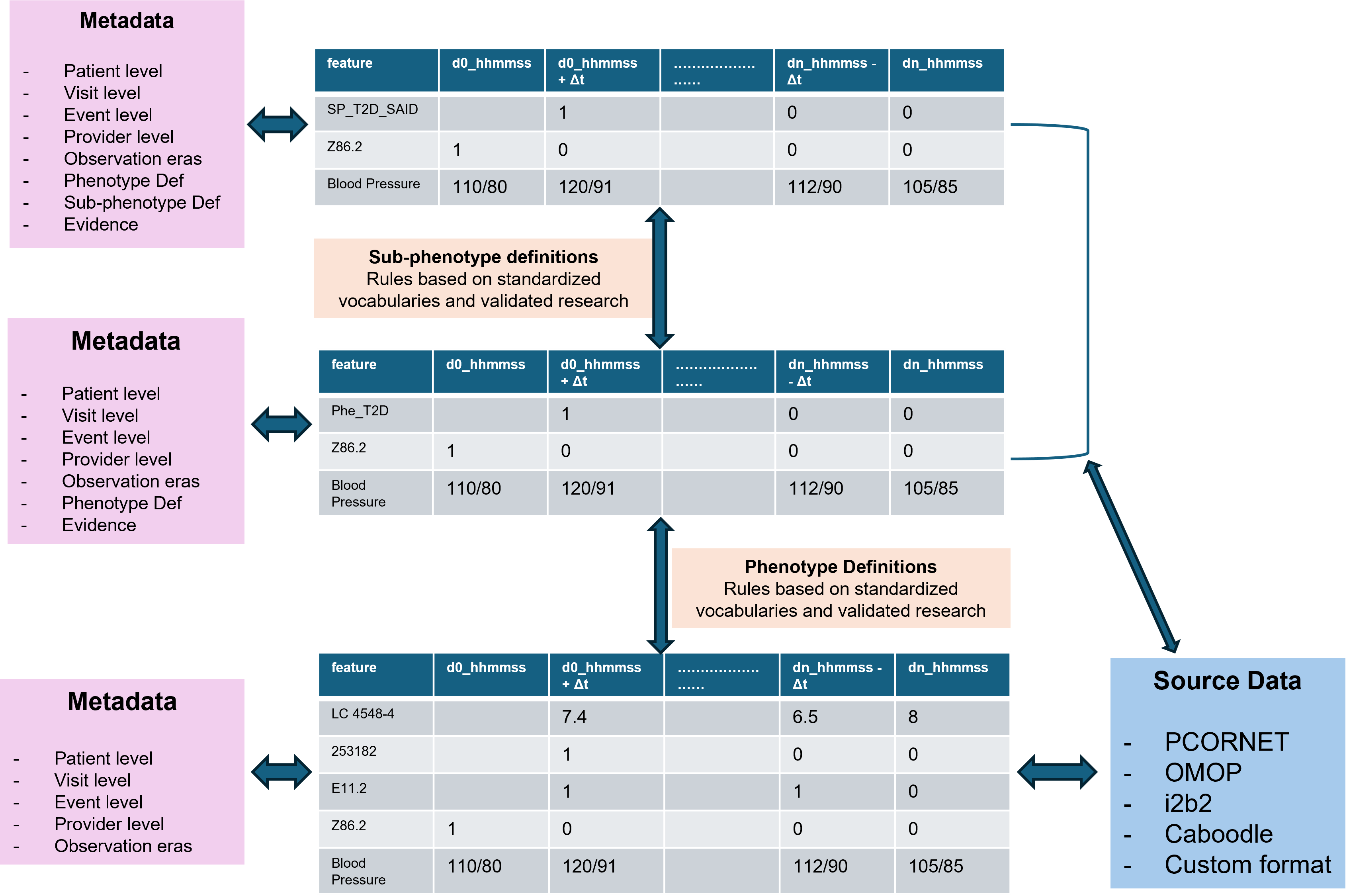
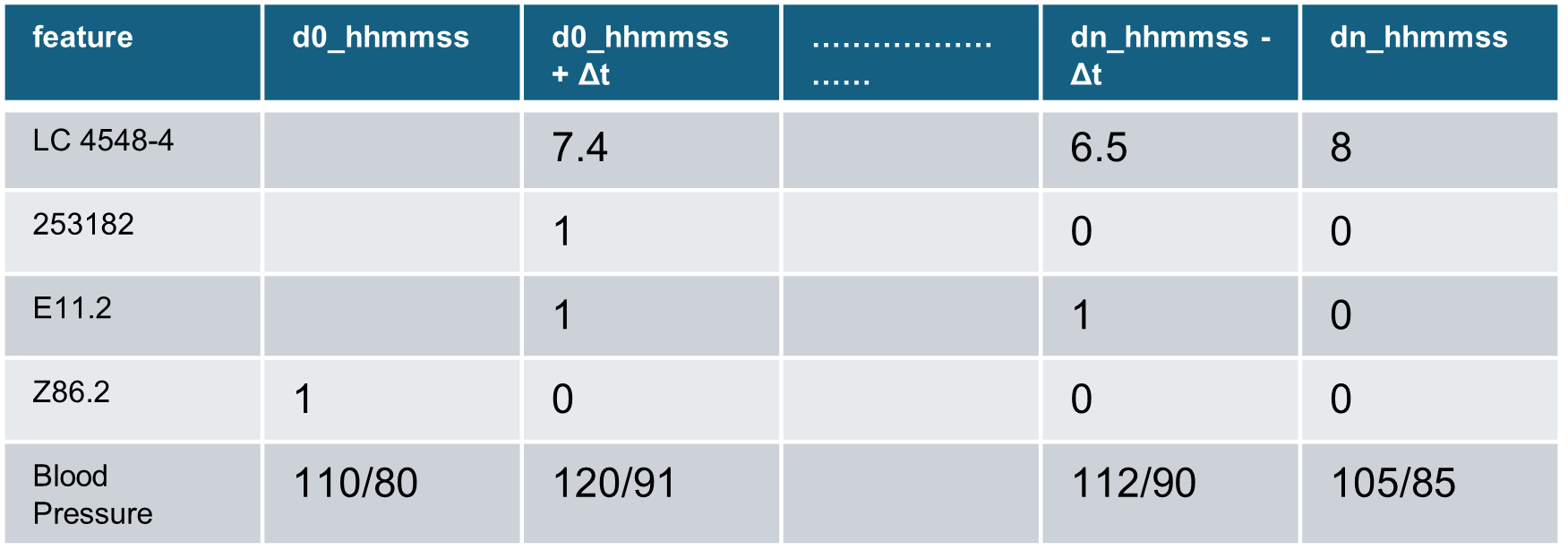
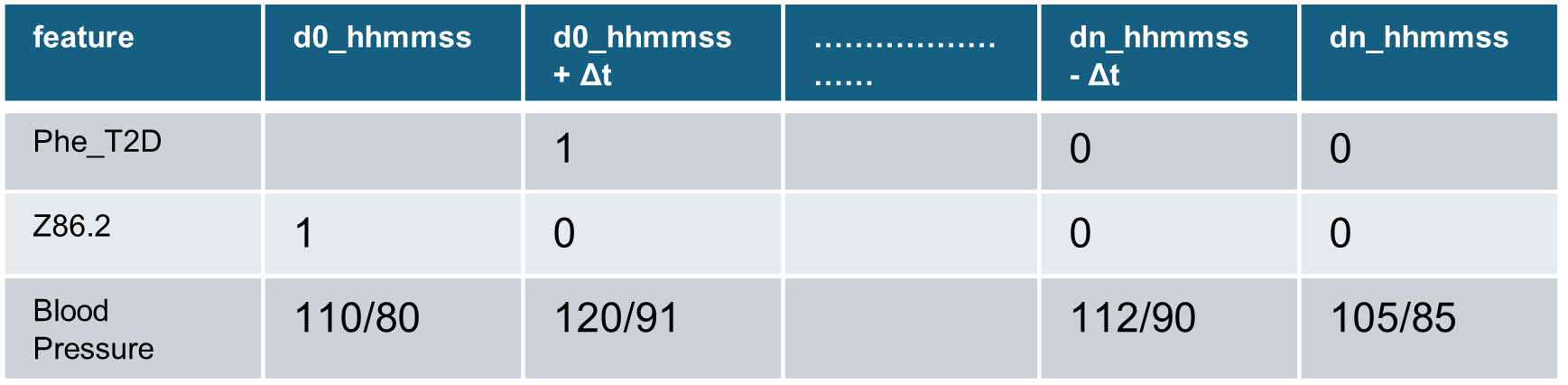
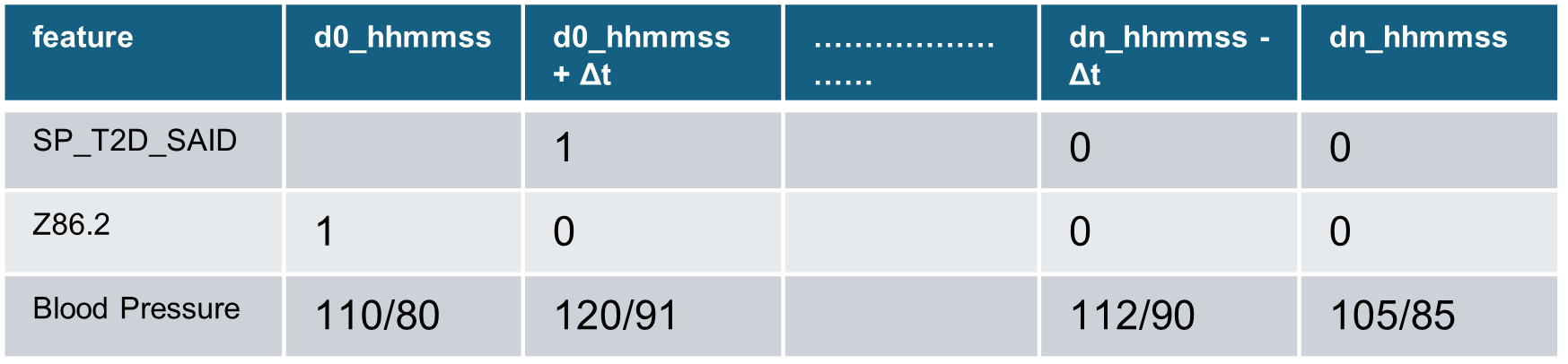
- A fixed coordinate system for EHR representation can align patient trajectories for mapping clinically relevant data in a deterministic manner
- The fixed coordinate tensor takes inspiration from genomic data representation
- Each patient will be represented as a point in a shared coordinate space
\(Health Coordinate = z(t) \in R^d\)
where \(z\) are the physiological coordinates, \(t\) is time since birth and \(R^d\) represents d-Dimension real space
- The health history of each patients becomes a sequence from birth -> present -> future
The Fixed Coordinate Temporal Data Model
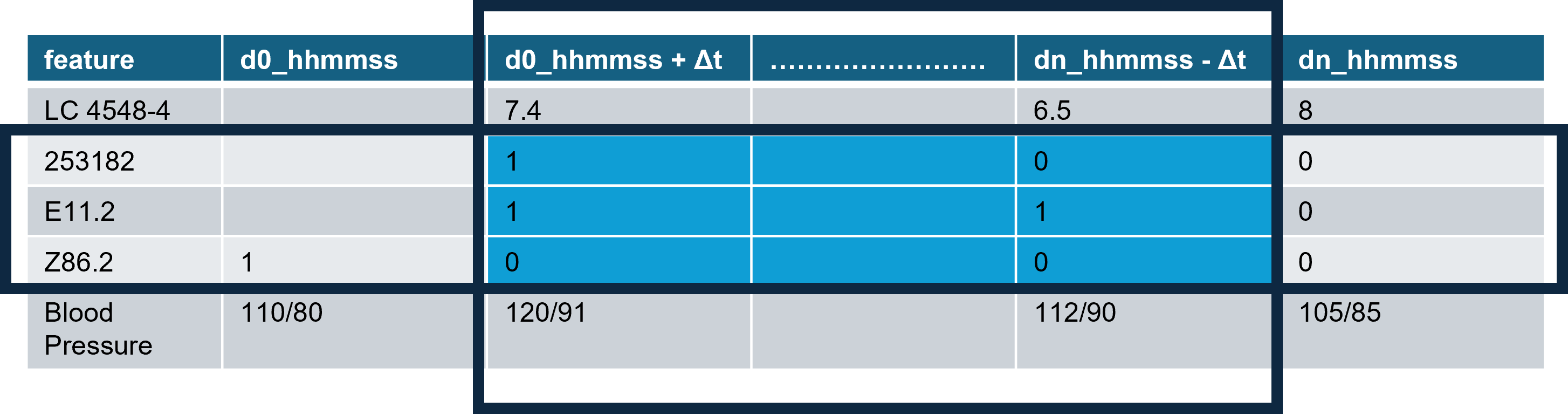
Dataset
Fully deidentified OMOP Dataset from UF Health IDR for COVID patients
The dataset consists of COVID-19 positive patients in UF Health EHR, and their records transformed into OMOP Common Data Model
Date Range : 2020 - current
The following OMOP CDM tables will be primarily used-
- person
- condition_occurrence
- drug_exposure
- measurement
- procedure_occurrence
- visit_occurrence
Dataset
Input
- Condition
- Drug
- Procedure
- Measurement
- Visit
- Time-ordered events
Index Event First diagnosis of COVID-19
Output Adverse event within 6 month post index
Key Design Decisions
Temporal Split - Data before the index date are treated as features
Date after the index date are treated as labels
Prevents leakage
Challenging since data was 2020 onwards
Cohort Balance - Balanced case-control in training
Sub-Sample: 500 patients - Due to resource intensiveness, the project was done on a proof-of-concept scale
- Controlled computational complexity reduced
Time Binning - Discrete event sequences for stability
Experimental Setup
- Models evaluated
- Logistic Regression
- Random Forest
- XGBoost
- Gated Recurrent Unit (FCT model)
- Metrics
- AUC-ROC
- Classification accuracy
- Embedding-based similarity
Results
| Finding Category | Key Results |
|---|---|
| XGBoost | 0.96 |
| Random Forest | 0.95 |
| GRU | 0.50 |
Key Observations
Why GRU underperformed
Sparse clinical sequences
Short observation windows (COVID cohort)
Weak temporal signal in dataset
Dominance of static patient features
Why tree models performed well
- Strong signal in:
comorbidities
baseline conditions
aggregated clinical history
In this dataset, patient outcome is primarily determined by static clinical state, not temporal evolution
- Implication:
- sequence modeling adds little value
- feature aggregation captures most signal
Strength of Feature-Based Models in this case
Advantages
- Robust to sparsity
- Works well with small datasets
- Handles categorical + count-based features naturally
- Less sensitive to missing temporal structure
Result
- higher performance
- more stable
- easier to interpret
FCT-Tensor Model : Strengths
Even though it under performed here, it provides the following capabilites
- Patient trajectory embedding
- Sequence similarity (phenotyping)
- Potential for digital twins
- Captures temporal dependencies (when present)
FCT-Tensor Model : Limitations
- Requires large longitudinal datasets
- Sensitive to padding and sparsity
- Needs dense event history
- Hard to train on small cohorts (like 500 patients)
- Weak signal if outcomes are static-risk driven
FCT-Tensor Model : Applications
Patient Similarity : find clinically similar trajectories
Disease Progession Modeling for chronic diseases
Digital Twin Simulation to observation invention effects
Early Warning System: For e.g. deterioration in ICU
FCT-Tensor Model : Future Improvements
Data improvements:
larger longitudinal cohorts
pre-COVID + post-COVID history
richer event sequences
For the report : try to use a different, more expansive OMOP dataset to compare sequence and feature based models
Model improvements:
attention mechanisms
transformer-based EHR models
event-type embeddings (drug/condition separation)
time-gap encoding
Conclusions
Feature-based models (XGBoost) outperform sequence models in this dataset
GRU underperformance is due to data structure, not model failure
Temporal modeling is valuable only when:
long longitudinal history exists
rich event sequences are available
Questions?
Thank you
This presentation was made using Quarto. Quarto enables you to weave together content and executable code into a finished document. Click here learn more about Quarto.

April 17th, 2026